€11.88 – €83.88Preisspanne: €11.88 bis €83.88
What is the Alu-Teufel Spezial? An acid-free wheel cleaner from TUGA Chemie GmbH with a thixotropic gel formula and a chemical colour indicator. The pH sits between 7.0 and 8.0 — skin-neutral and cleared for every common wheel type: aluminium, chrome, anodised, diamond-cut, powder-coated. The main active, sodium thioglycolate (CAS 367-51-1), reduces baked-on iron(III) oxides from brake dust into water-soluble iron-thioglycolate complexes. That exact reaction turns the gel from clear-green to red-violet — you can see when the cleaning is done. Not suitable for tar-type soiling or bitumen.
Alu-Teufel Spezial (Green) is TUGA Chemie’s pH-neutral wheel cleaner and a benchmark product in the DACH detailing market — in the GTÜ’s Auto-Bild tests from 2016 and 2019 it landed consistently in shared second place with a ‚highly recommended‘ rating, beaten only by the premium heavyweight Dr. Wack P21S High End. The formula is built on sodium thioglycolate as the chemically active reducing agent, a surfactant matrix of Sodium Laureth Sulfate (anionic) and Capryl Glucoside (a nonionic sugar surfactant), plus Xanthan Gum as a natural thickener.
TUGA Chemie in Osnabrück has been making these formulas in Germany for decades, supplying commercial detailers, workshops and serious private owners across the DACH region.
The xanthan makes the gel pseudoplastic — a trait of non-Newtonian fluids where viscosity drops under shear and snaps straight back at rest. On the trigger the gel thins out and atomises finely; the moment it hits the vertical wheel face the viscosity returns and the gel clings statically. Contact time on the surface climbs massively without the product running off early.
The actual cleaning runs in four phases: adhesion via the gel, wetting and creeping under lipophilic soiling by the surfactants, chemical reduction of the iron(III) oxides from brake dust by the sodium thioglycolate, and finally the chromophore shift — the complex formation changes the light-absorption spectrum and the gel turns red-violet. Rinse before the colour flips and you’ve pulled the cleaner off too soon.

Detailing1’s tip from the shop: Day-to-day, the biggest efficiency jump with the Alu-Teufel Spezial doesn’t come from the chemistry itself but from the spray bottle. The original TUGA head atomises in spots rather than a fan — people compensate by drowning the wheel, 100 ml and more per wheel instead of the ideal 30 to 50 ml. The pro trick: decant the gel into a Kwazar Mercury Super Pro+ or IK Multi TR 1 — both have acid- and alkali-resistant Viton or EPDM seals and mist the thixotropic gel far more finely. Consumption drops by around 40 percent with better cleaning. Plus the standard rule: the wheel has to be cold (at least 30 minutes after driving), never in the sun, strictly 5 minutes dwell time — any longer and the concentrated actives etch the clear coat.
The standard workflow starts with a temperature check. Wheels and brakes have to be down to ambient temperature — in direct sun, move the car into the shade first or push the wheel job to the morning or evening.
Before you lay the cleaner on, rinse the wheel down with clear water or the pressure washer — loose road grime and brake-dust crumbs come off, so the gel works more efficiently. Spray the Alu-Teufel Spezial evenly from 20 to 30 centimetres, bottom to top. That direction matters: work top-down and you build a concentration gradient and run marks that can stay visible once they dry.
Dwell time is three to five minutes, until the red-violet indicator has developed across the whole face. On heavily soiled or long-neglected wheels you can agitate again with a soft detailing brush or a dedicated wheel brush — circular strokes, no pressure, so the gel spreads more evenly and the surfactant can emulsify the last layers of dirt.
Then rinse it off spotlessly with a sharp high-pressure jet: first bottom to top (lifts the lower wheel edge), then with clear water top to bottom (flushes every residue safely into the wheel well). Don’t forget the back of the wheel and the gaps between the spokes — that’s where most of the brake dust collects.
After rinsing the wheel should look clean. With baked-on brake dust a second pass with a longer dwell time can be needed — but never past the maximum 5 minutes in one go. If you can’t get the wheel clean in a single round, run two passes with a high-pressure rinse in between rather than letting it dwell longer once.

The Alu-Teufel Spezial’s chemical specialism is iron-based soiling. Sodium thioglycolate is a reducing agent that reacts specifically with iron(III) ions — baked-on brake dust from sintered particles, flash rust on wheel edges, oxidised metal swarf from tyre wear. That’s the core competence and the reason for the indicator’s colour flip.
What the cleaner won’t shift: tar, bitumen, fresh rubber residue on the wheel lip or oily soiling from leaking brake cylinders. For tar and bitumen a dedicated tar and adhesive remover is the right call. The Alu-Teufel can emulsify some of it mechanically, but that’s not where the formula’s strengths lie and it just burns through product.
One important limit is the maximum dwell time of 3 to 5 minutes. Blow well past that window and the water content of the gel evaporates. The concentration of the surfactants and the sodium thioglycolate spikes locally in the remaining droplets, which can cause irreversible chemical etching of the clear coat — visible as matt, milky patches that no amount of aftercare will undo. The GTÜ warns explicitly against leaving cleaning fluids sitting on paint or wheels under thermal load.
In the professional detailing world the Alu-Teufel Spezial is often used ‚off-label‘ as a large-area flash-rust remover on car paint — the sodium thioglycolate’s reducing action also works on iron particles embedded in clear-coat layers. TUGA Chemie doesn’t officially include this use case, but in detailing practice it’s an established method. If you go this route, wear strict PPE (nitrile gloves, eye protection) and keep the dwell-time limits even more conservative — paint is less forgiving than tough wheel clear coats.

Demand for good wheel cleaners in the DACH market follows an extremely cyclical pattern tied straight to the well-known ‚Easter-to-October‘ rule of thumb: summer tyres from Easter to October, winter tyres from October to Easter. Five years of Google Trends data for ‚Felgenreiniger‘ show a measurable rising wave: the current 8-week average of index 75 sits around 47 percent above the 12-month mean of 51 — the sharpest seasonal peak in April, a factor of 3 over the January low. Ahead of every wheel change — so March/April and September/October — demand for wheel cleaners explodes, because businesses and private users want the wheels properly cleaned before storage. Take baked-on brake dust into storage over the summer and after six months you’ve got soiling that’s twice as hard to remove.
In winter itself consumption is high because of road-salt corrosion and grit spray on the inner wheel faces. In summer it’s harder braking at higher temperatures and more motorway miles. The seasonal peaks are clear: mid-March, mid-September, plus the run-up to big tuning events like Tuning World Bodensee or the Essen Motor Show, where the wheels have to be shown off flawless.
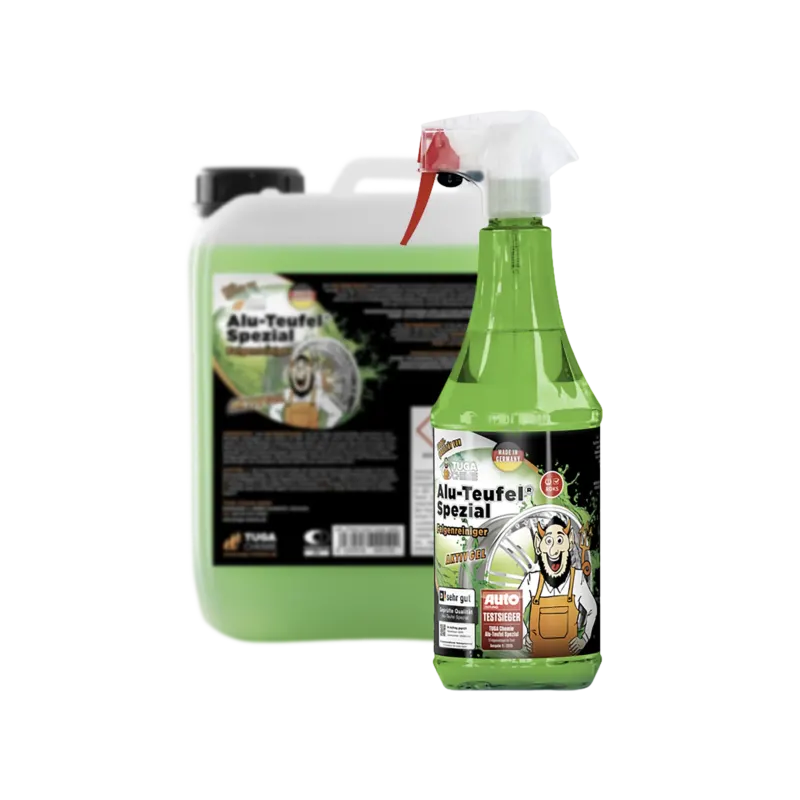
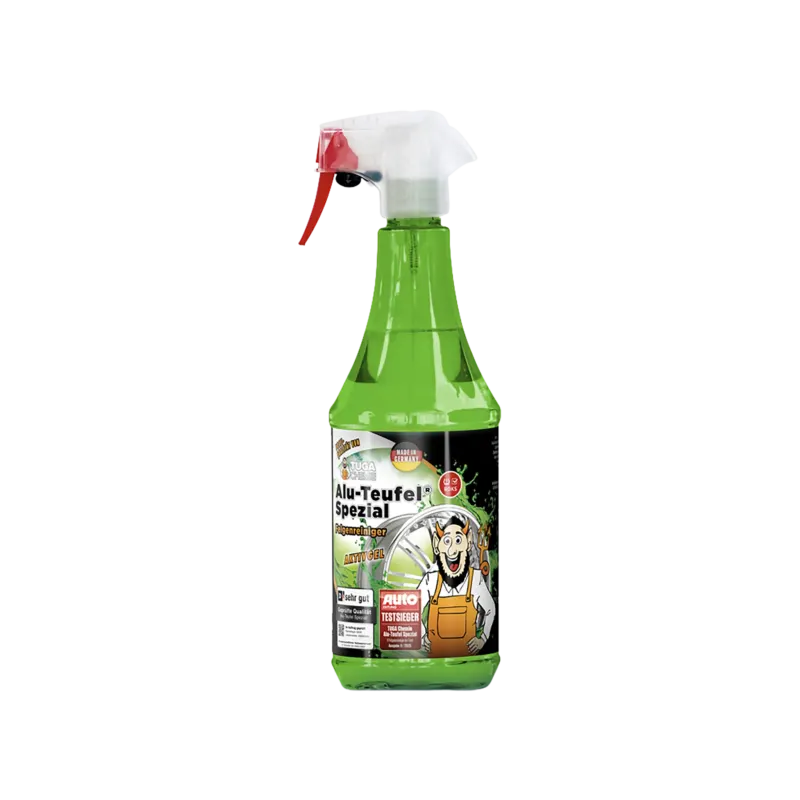
The 1-litre spray bottle at around 13 EUR is the easy way in for one or two cars in a private household. At weekly wheel cleaning and roughly 80 to 120 ml per full clean (four wheels plus inner faces), a litre lasts around eight to twelve cleaning cycles — a quarter’s supply in everyday use.
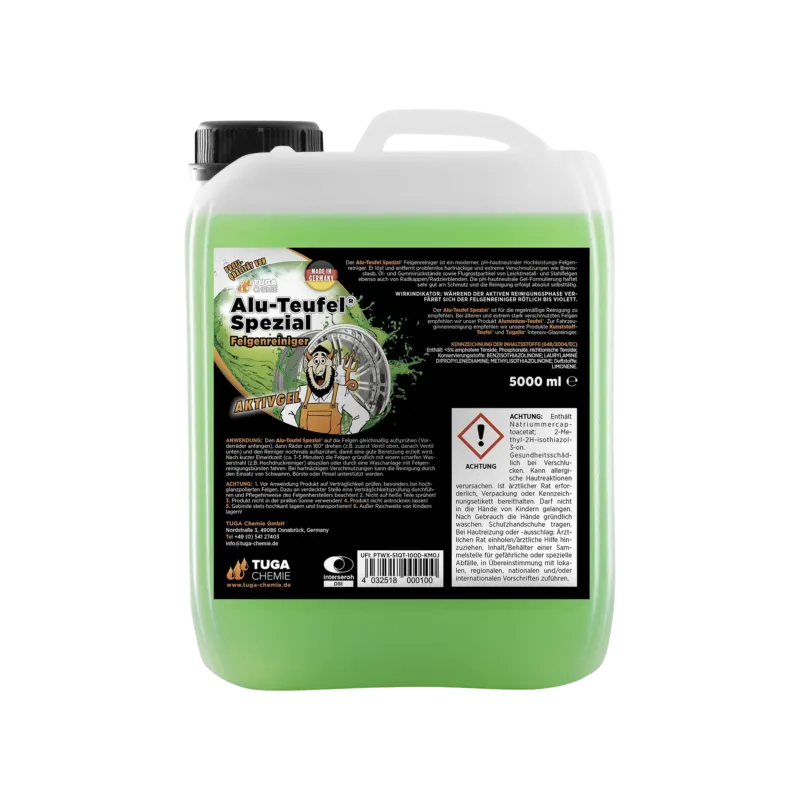
The 5-litre canister at around 33 EUR saves about half per litre and is the right size for workshops, small to mid-size detailers and households with three or more cars. Run a mobile detailing service cleaning ten to fifteen cars a week and the 5 L canister keeps you going two to three months. The pump head off the 1-litre bottle screws off and moves onto a separate empty bottle — the established fix, because the 5 L canister itself isn’t made for spraying.
Safety note for professional use: the product falls under GHS07 with hazard statements H302 (harmful if swallowed), H317 (may cause an allergic skin reaction) and EUH208 (contains methylisothiazolinone and benzisothiazolinone — may produce an allergic reaction). VOC content is around 30 g/L (about 3 percent). With several applications a day in enclosed detailing bays, ventilation is a must — doors wide open or extraction running — and nitrile gloves make sense even for private use, especially with sensitive skin.