€13.88 – €58.88Preisspanne: €13.88 bis €58.88
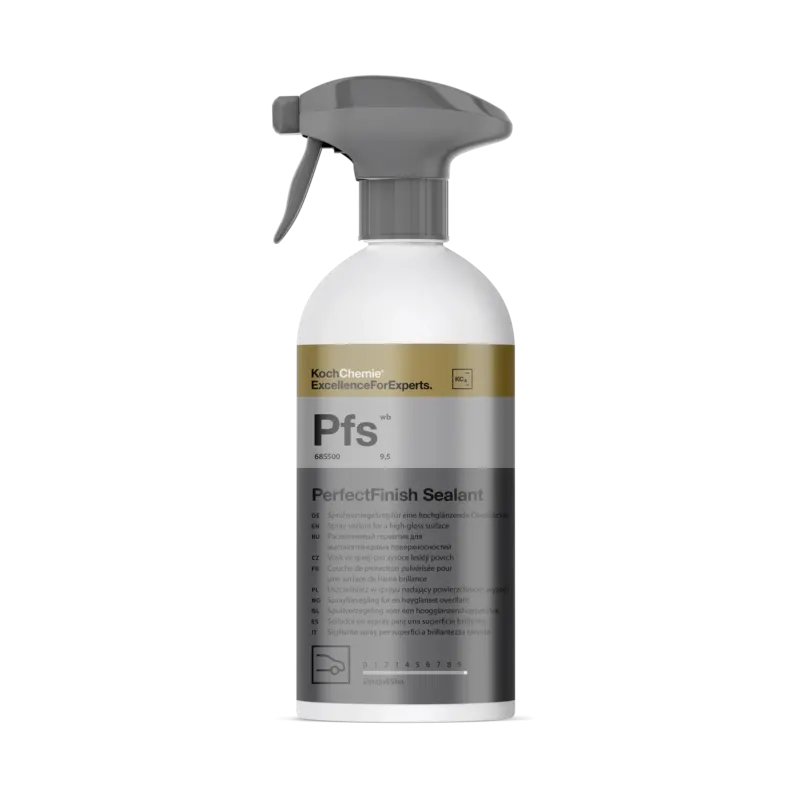
The PerfectFinish Sealant „Pfs“ is a ready-to-use spray sealant from Koch-Chemie on a polymer base. It gives deep colour, a noticeably soft paint surface and is cleared as a topping over cured ceramic coatings. But it’s no substitute for a full ceramic coating, and it’s not meant for bare plastic or unpainted rubber.
Spray sealant means: a liquid protective film that flashes off in a short time and sets into a thin polymer layer. The PerfectFinish Sealant „Pfs“ from Koch-Chemie is the pro update of this category. Synthetic polymers instead of quartz, noticeably thicker than a typical quick detailer, and you can work it by hand or by machine. Painted surfaces, painted wheel aluminium and cured ceramic coatings are cleared. Bare plastic, unpainted rubber and open-pore leather are not.
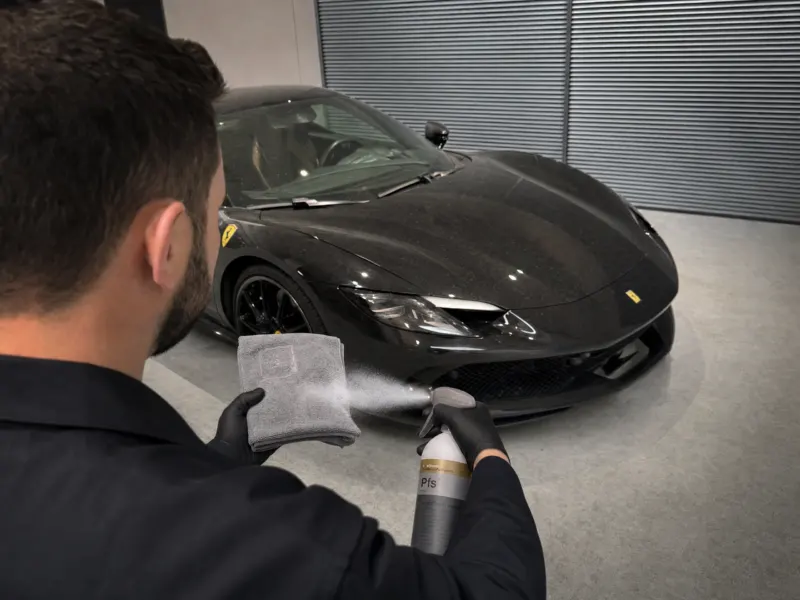
Day-to-day from Detailing1: We see the same beginner mistake all the time — spraying straight onto the paint. The emulsion-like consistency throws clouds, streaks and overspray onto glass and rubber. What we see day-to-day: put 1 to 2 sprays onto a short-pile microfibre, then lay it down in a cross pattern. Horizontal first, then vertical, with overlapping passes.
At 18 to 22 degrees Celsius the product hazes up after 1 to 3 minutes. Pros call it „hazing“ — the surface visibly dulls as the carrier flashes off. Only then buff it off streak-free with a clean side of the cloth. For the next 24 hours keep water, washing and moisture away. The polymers need that time to cross-link, otherwise the layer partly breaks down in the next rain.
The PerfectFinish Sealant works differently from a quick detailer. It needs dry, clean, grease-free paint, otherwise the polymer chains won’t grab. The full workflow from pre-wash to sealing takes about 90 minutes on a mid-size car.
The steps: touchless pre-wash with snow foam, then a manual two-bucket wash with pH-neutral shampoo, then dry thoroughly. Ideally with a blower, so no leftover water runs out of door shuts or panel gaps. If you mix the Pfs up with the in-house Hydro Foam Sealant „S0.03“, you’ll be let down: the S0.03 is a wet sealant applied through the foam lance, the Pfs needs it bone dry.
Before you apply, degrease the paint with a panel-prep spray — that’s the step hobby users skip most. Only grease-free paint lets the polymers grab; otherwise you get a nice look for three days and then nothing.
Apply in a cross pattern — horizontal and vertical with overlapping passes over the microfibre. Let it flash off for 1 to 3 minutes, then buff with a fresh side of the cloth. In warm weather above 22 degrees the window shrinks to 60 to 90 seconds; then work panel by panel instead of the whole car. Never use it in direct sun — the product dries before it reacts and leaves visible smears.
For machine use Koch-Chemie clears 1,000 OPM max: minimal pressure, slow passes, an extra-soft Polish & Sealing Foam Pad. That spreads the product ultra-fine and maxes out the gloss. For hobby users the step only pays off on dark paint or right after a polish — for everyday care the hand-applied cross pattern is enough.
Important: never use it below 10 degrees, never on hot paint in direct sun. Both extremes wreck the polymer chains. In the cold the carriers turn thick and flash off unevenly; in the heat the product dries before you can buff it. Sweet spot: 18 to 22 degrees, shade or indoors, still air with no dust flying around.
The Pfs gives excellent looks and feel, but it’s no all-year sealant in the durability-test sense. On the bonnet and roof the water beading holds several weeks with normal use. On the rear, lower door flanks and sills the polymer layer visibly breaks down after around 500 kilometres of winter driving, from road salt and mechanical spray. A German detailing channel showed exactly that in a documented 14-day durability test.
What it does well: aggressive bug removers and alkaline pre-washes only cost it 10 to 15 percent of its hydrophobia. The chemical resistance is surprisingly high for a pure polymer sealant. What it can’t do: treat unprotected plastics (polypropylene goes white), seal unpainted rubber, or touch glass without a smearing risk. For glass you need a separate glass sealant — the polymers in the Pfs would streak across your line of sight, and you’d only get them off again with polishing compound.
A second honest limit: the Pfs is no beading miracle in the maximum-droplet sense. If you want dramatically high water beads like on a fresh ceramic coating, here you’ll see softer roll-off water — it protects just as well, it’s just more low-key to look at. The product is tuned for slickness and deep gloss, not the show effect in a water test.
If you want an all-year protective coating effect, a real ceramic coating is the right call. It has far longer durability and higher mechanical resistance than any polymer spray sealant — but you’re swapping a 30-minute spray job for a multi-hour application with a curing tent or garage. If instead you want a care topping that delivers deep gloss and slickness and can be machined on, the PerfectFinish Sealant is the product for you.
If you know the predecessor Spray Sealant „S0.02“: the Pfs is the denser, slightly more demanding, but more durable evolution with a reworked polymer structure. With it Koch-Chemie deliberately tackled the main criticism of the S0.02 — the poor durability. In return the buffing is a bit more work, because the consistency is thicker.
The target group is ambitious hobby detailers who want a clean finish after polishing, and pro valeters who need one last slickness highlight after the coating. For pure car-wash drivers with no prep, the Pfs is too demanding. The 24-hour cure doesn’t fit the quick programme.
Coverage as an anchor: a 500 ml bottle covers about 20 to 25 car applications (mid-size, roughly 20 ml per car in a cross pattern over the cloth). The 5-litre pro container pays off from around 80 applications per season or in a valeting business. If-then, translated: 500 ml for one or two of your own cars a year, 5 litres once you’re regularly sealing customer cars.
In the trends data, searches for „spray sealant“ climb noticeably from April. The start of the season is the natural point for the yearly protective layer after the winter wear — and that same window is, in our experience, also the supply-bottleneck month, because a lot of valeters reorder at the same time.
In the workflow the Pfs pairs well with the Quick & Shine „Qs“. Quick detailer as a refresh between washes, Pfs as the base sealant renewed every 4 to 6 weeks. For the regular wash stick to pH-neutral shampoo so the polymer layer survives. Alkaline pre-washes are fine, but not every week.
The trick no manufacturer marketing leads with: if you’ve just laid down an expensive ceramic coating like the Ceramic Allround „C0.02“, put the Pfs on top as a sacrificial layer for the first few weeks. Fresh ceramic is prone to water spots during the curing phase, until the quartz network is fully hardened.
The Pfs polymers stop limescale from burning into the still-open coating. The spray sealant washes off after 4 to 6 weeks, the ceramic is fully cured by then, and the expensive coating underneath stayed clean. What we see day-to-day: in the detailing summer that’s the most cost-effective protection stack you can run over a fresh ceramic coating.